
The Sacrificial Lamb

Last week, CVS Health announced that it was breaking itself apart.
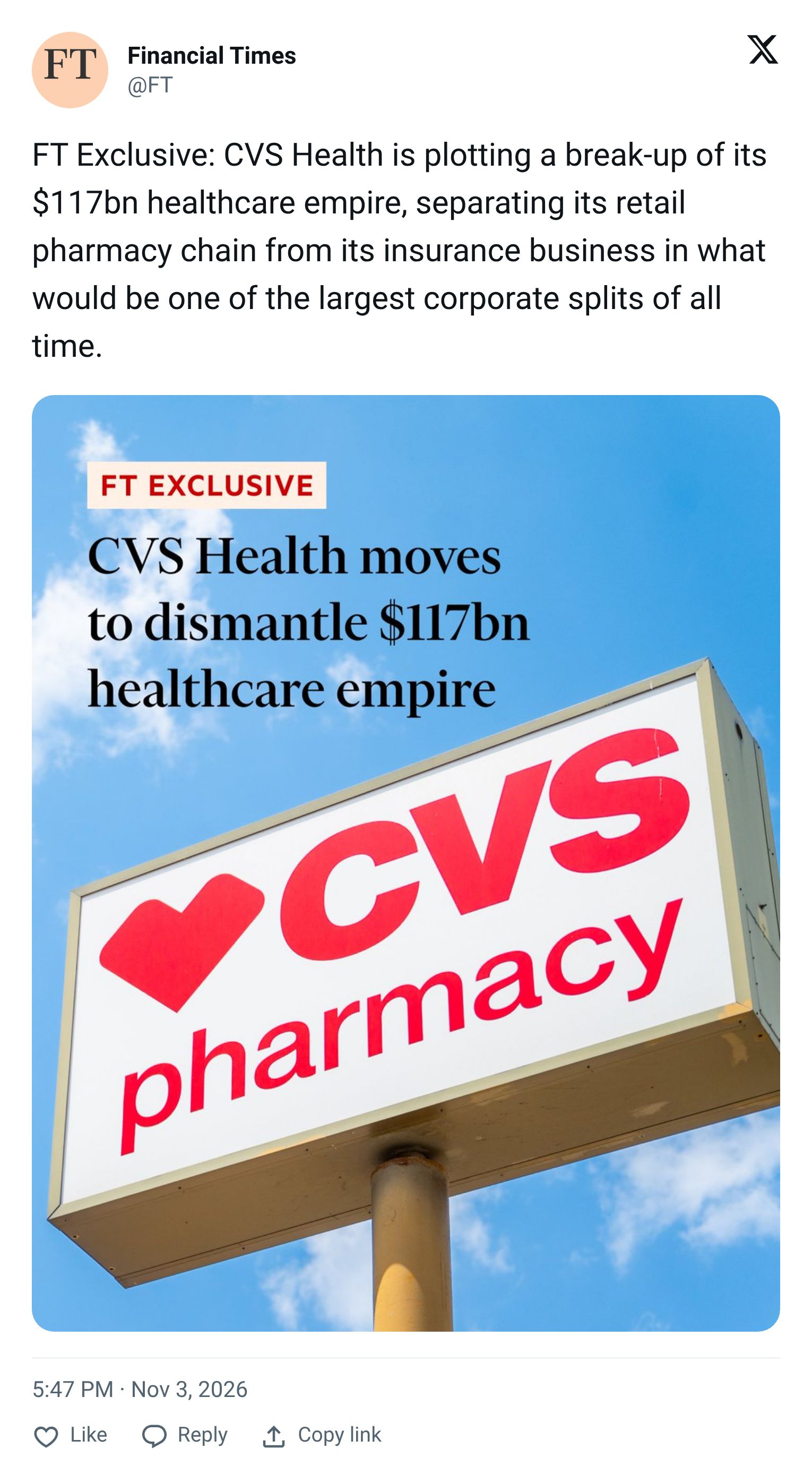
After spending nearly two decades assembling one of the largest vertically integrated healthcare companies in America, CVS is separating its roughly 9,000 retail pharmacies into a standalone, publicly traded company. The rest of its healthcare empire, including Aetna, CVS Caremark, and CVS Specialty, will remain together. The separation is not expected to be completed until the first half of 2028, and it still requires final board approval and an SEC registration filing. But for anyone who has followed the growing political backlash against vertically integrated healthcare companies, this sounds like a pretty big deal.
Senator Elizabeth Warren certainly thought so. She celebrated the announcement as evidence that CVS was finally responding to public pressure to break up the healthcare conglomerates dominating American medicine. Although she was quick to point out that the company wasn't going nearly far enough. I agree.

Warren and Republican Senator Josh Hawley have been pushing legislation to separate pharmacy benefit managers (PBMs) from the pharmacies they own. Arkansas and Tennessee have pursued similar restrictions at the state level. CVS has spent considerable time and money fighting these efforts.

And now, seemingly out of nowhere, CVS is voluntarily doing something that looks an awful lot like what its critics have been demanding.
How convenient.
My interpretation is that this is a whole bunch of nothing. At least as far as meaningful healthcare reform is concerned.
I suspect CVS has found a way to give politicians something that looks like a victory while simultaneously getting ahead of a business decision it was probably going to have to make anyway.
And the more I think about it, the more revealing I find the part of the company CVS has decided it's willing to live without.
The pharmacy.

The Breakup That Isn't
To understand what's happening, you need to understand what CVS actually owns.
In 2007, CVS acquired Caremark, one of the country's largest PBMs, for approximately $27 billion. In 2018, it acquired health insurer Aetna for roughly $70 billion.
The theory behind these acquisitions was that combining the companies responsible for insuring patients, managing their prescription benefits, and dispensing their medications would create a more efficient healthcare system.
CVS could manage your insurance, decide which medications were covered, negotiate their prices, and fill your prescriptions. Eventually, it could even provide some of your medical care.
One big, happy healthcare family.
Of course, I've written extensively about why this arrangement creates enormous conflicts of interest. When the company deciding which pharmacies you can use also owns the pharmacies it would prefer you use, whose interests do you think come first?
This is the problem that Warren, Hawley, and an increasingly bipartisan collection of lawmakers have been trying to address.
So what exactly is CVS breaking apart?
The new CVS Pharmacy company will inherit the traditional retail drugstores, mail-order pharmacies, MinuteClinics, and the Health100 technology services business.
The remaining CVS Health will retain Aetna, Caremark, CVS Specialty, Oak Street Health, Signify Health, and Cordavis, its biosimilar subsidiary, along with other healthcare businesses.
What does that really mean?
The insurer, the PBM, and the specialty pharmacy are all staying together.
Caremark will still have the ability to influence which medications patients receive and where they fill them. CVS Specialty will still be positioned to dispense some of the most expensive medications in America, including treatments for cancer, autoimmune diseases, and other complex conditions.
The underlying conflicts of interest haven't magically disappeared.

As Antonio Ciaccia, a longtime advocate for pharmacy reform, put it on social media, CVS “just scraped the cream off the top of their business and then cut the dead weight.” Ciaccia conceded the move might still count as healthy progress. But his fuller verdict is the sharper one: “This isn’t breaking up big medicine. It’s clinging to big medicine and unloading the leftovers.”
Mark Cuban was similarly unimpressed. He described the spinoff as a smart move for CVS but essentially a non-event for the cost of healthcare. The two companies can continue working together through contracts, and the ultimate ownership structure remains an important question.

He's right.
You don't need to own a pharmacy to direct prescriptions to it. You can accomplish much of the same thing through contracts, preferred networks, and reimbursement arrangements.
The separation may change the corporate structure, but that doesn't necessarily mean it changes the underlying economics.
And I suspect that's precisely the point.

The Sacrificial Lamb
Here's where I think this story gets interesting.
For years, CVS has argued that its retail pharmacies were an essential component of its integrated healthcare strategy.
But the economics of operating a traditional pharmacy have become increasingly miserable.
Reimbursement from PBMs has been squeezed. Labor, rent, insurance, and operating expenses have increased. Patients have become accustomed to getting practically everything delivered to their doors. Meanwhile, companies like Amazon, Walmart, and Costco have made it near impossible for traditional drugstores to compete on price.
And CVS has thousands of enormous retail locations to maintain.
Adam Fein, who has spent decades analyzing the pharmaceutical supply chain at Drug Channels, highlighted a particularly revealing statistic in his analysis of the breakup.

Front-store merchandise generates only about 15% of CVS's Pharmacy & Consumer Wellness segment revenue, despite occupying approximately 80% of a typical store's retail square footage.
Think about that.
CVS has spent decades maintaining giant stores filled with shampoo, candy, greeting cards, and overpriced household essentials, while customers today purchase those products elsewhere.
And the prescription counter, which brings customers into the building, operates in an industry where reimbursement has become increasingly difficult.
Not exactly a recipe for success.
CVS has already been closing hundreds of stores, and the traditional American drugstore is under tremendous pressure.
Now consider what CVS Health is keeping.
An enormous insurance business. One of the largest PBMs in America. A specialty pharmacy operation dispensing some of the most expensive medications on the market. A biosimilar business positioned to participate in the rapidly evolving market for complex drugs.
These businesses have their own challenges, but they also offer something that traditional retail dispensing increasingly does not: the opportunity to control the economics surrounding prescription drugs rather than simply participate in them.
I'm not suggesting that CVS's retail pharmacies are worthless or that the new company cannot succeed. A standalone CVS Pharmacy may actually gain flexibility to negotiate with other PBMs, develop cash-pay services, and rethink its retail footprint.
But I find it telling that when CVS was forced to reconsider the structure of its healthcare empire, the business it chose to separate was the one most directly associated with its name.
CVS Pharmacy.
The pharmacy has become the sacrificial lamb.

I've Seen This Movie Before
I spend my days operating an independent pharmacy in New York City. I've watched the economics of this industry deteriorate firsthand.
I've written before about my pharmacy's $2 million Ozempic problem.
Over the course of a year, C.O. Bigelow spent more than $2 million purchasing GLP-1 medications and lost approximately $26,000 dispensing them, even before accounting for certain additional fees.
We were purchasing expensive medications, employing licensed professionals to dispense them safely, counseling patients, maintaining inventory, and assuming the financial risks of operating a pharmacy.
And we were losing money for the privilege.
That is not an unusual story in American pharmacy. It's the business model.
I've argued repeatedly in this newsletter that the future of pharmacy cannot depend exclusively on dispensing prescriptions.
The traditional model assumes that pharmacies can make enough money on the medications they dispense to subsidize the professional services pharmacists provide.
But when the reimbursement on the medication itself is inadequate, that arrangement starts falling apart.
The irony is that pharmacists are arguably more valuable than ever.
Patients are taking increasingly complicated medications. They're getting prescriptions from multiple doctors, telehealth companies, online pharmacies, and specialty providers. They need someone who understands the entirety of their medication regimens, identifies problems, answers questions, and helps them navigate a healthcare system that has become almost comically difficult to understand.
Yet our profession continues to be compensated primarily for putting pills into bottles.
I've said it before, and I'll say it again: The prescription is not the care.
The medication is a product. The pharmacist provides a service. Until we develop a sustainable way to compensate pharmacists for that service, traditional pharmacy will continue to struggle.
And that's why I find the CVS announcement so fascinating.
The largest pharmacy chain in America is effectively acknowledging that owning thousands of traditional pharmacies is no longer essential to its broader healthcare strategy.
I don't think that means pharmacies are going away. People will always need medications, and many will continue to value having a pharmacist they can speak to face-to-face.
But it does suggest that the future of the pharmacy business may look very different from the past.
Smaller footprints. More specialized services. More direct relationships with patients. Less dependence on dispensing volume as the sole measure of success.
For independent pharmacies like mine, adapting to that reality is a matter of survival.
For CVS, apparently, it's a matter of corporate restructuring.
A Convenient Divorce
To be fair, there are legitimate reasons for CVS to pursue this separation beyond political pressure or deteriorating retail economics.
Fein argues that the supposed synergies between CVS Pharmacy and Caremark were exaggerated from the beginning.
Owning a PBM gave CVS pharmacies a way to attract prescriptions. But owning thousands of retail pharmacies offered Caremark a much less compelling advantage.
Separating the businesses could give the new CVS Pharmacy more freedom to negotiate with competing PBMs, develop new partnerships, and make decisions based on the economics of operating pharmacies rather than the priorities of a much larger healthcare conglomerate.
That's a reasonable argument.
And I wouldn't be surprised if the new CVS Pharmacy ultimately becomes a more efficient business because of the separation.
But none of that changes my broader interpretation.
CVS is facing increasing political pressure over its vertical integration. It also owns a sprawling retail pharmacy operation facing serious structural challenges.
The company has found a solution that addresses both problems at once.
It can point to the breakup as evidence that it is responding to regulators and lawmakers. It can separate a capital-intensive retail business from its other operations. And it can preserve the relationships between its insurer, PBM, and specialty pharmacy that remain central to its healthcare strategy.
It's a remarkably tidy arrangement.
Cuban raised one more point worth watching: depending on the final structure, the two companies may retain continuing ownership relationships even after the separation.
Even if the companies become completely independent, the underlying market incentives don't necessarily change.
Caremark will still have enormous influence over prescription drug spending. CVS Specialty will still operate within the same corporate family as Caremark and Aetna. And traditional pharmacies, whether owned by CVS or independent operators like me, will still have to navigate a reimbursement system largely controlled by a handful of powerful intermediaries.
I don't see how any of that meaningfully changes the cost of healthcare for the average American.
And I'm skeptical that it was ever intended to.

The Writing on the Wall
For nearly twenty years, CVS told us that the future of healthcare was bringing everything under one roof.
The pharmacy. The PBM. The insurer. The doctor.
The argument was that combining these businesses would make healthcare more efficient, more convenient, and ultimately more affordable.
Now CVS is telling investors that its traditional pharmacies might be better off operating separately.
Maybe they will be.
But I think the announcement tells us something much more important than whether CVS has found the optimal corporate structure.
It tells us where the company believes the future value of healthcare lies.
Not necessarily in the neighborhood drugstore. Not in the pharmacist who knows your name or the professional who spends twenty minutes helping you understand your medications.
But in the businesses that manage, finance, and control the flow of prescription drugs.
I have spent much of my career arguing that American pharmacy is being financially strangled by the very companies that claim to be making healthcare more efficient.
And now one of the largest of those companies has decided it might be better off separating itself from the traditional pharmacies that dispense those prescriptions.
The company that helped make dispensing prescriptions such a difficult business has decided that owning the pharmacies may no longer be worth the trouble.
Politicians can call it progress. CVS can call it a strategic transformation.
From where I sit, behind the counter of an independent pharmacy, it looks an awful lot like the writing on the wall.

Alec Wade Ginsberg, PharmD, RPh
4th-Gen Pharmacist | Owner & COO, C.O. Bigelow
Founder, Drugstore Cowboy
