
When Hope Isn't FDA Approved

Last week, a story went viral about a 30-year-old New Yorker who traveled halfway around the world to China to get cancer medication for his mother.
I happen to know him.
Max Doppelt was my younger brother’s roommate in college, and I’m proud to call him one of my own friends as well. His mother, Debbie, was diagnosed with lung cancer in 2023 at age 60. Despite chemotherapy, immunotherapy, and surgery, the cancer eventually spread to her brain. By early 2025, her options were running out.
There was, however, a promising medication called sunvozertinib, developed by a Chinese pharmaceutical company, that targeted the specific genetic mutation driving her cancer. It had been approved in China in 2023, but not yet in the United States. Debbie wasn't eligible for the clinical trial at Memorial Sloan Kettering that might have offered another targeted therapy, and the available American trial of sunvozertinib carried the possibility of being placed in a placebo/non-treatment group without knowing it.
So Max did what I imagine any devoted son would desperately want to do, but very few could actually pull off.
He figured out how to get the drug himself.
And I don't mean he booked a flight to Shanghai, walked into a pharmacy, and handed over his credit card. If only it were that simple.
He went full James Bond.
I've spoken with Max about his experience and the stories are unbelievable. The international coordination, the connections, the logistics of tracking down a medication without speaking the native language. Listening to him describe it, I felt like I was hearing about some elaborate international intelligence operation.
Except the mission wasn't to steal government secrets. It was to save his mother's life.
Max eventually returned from Shanghai with 26 boxes of sunvozertinib hidden in his suitcase, purchased for approximately $10,000.
Today, more than a year and a half after beginning treatment, Debbie's cancer has remained largely under control, with the help of additional radiation treatments and dose adjustments. The drug received FDA approval in July 2025, although it still hadn't reached the American market when the story was published last week.
I have tremendous admiration for what Max did. It's difficult to comprehend the emotional weight of being responsible for finding a treatment that could keep your mother alive.
But as I read the article, I kept thinking about another cancer patient who fought for access to a medication that the FDA didn't want her taking.
My Aunt Betsy.

Fifteen Years Earlier
In 2011, my aunt, Betsy Swersky, was fighting metastatic triple-negative breast cancer.
For anyone unfamiliar, triple-negative breast cancer is a particularly aggressive form of the disease that lacks the three molecular targets used by several major breast cancer treatments. At the time, treatment options were considerably more limited than they are today.
Betsy was given a terrible prognosis.
One of the medications she was receiving was Avastin (bevacizumab), a drug that works by inhibiting the formation of blood vessels that tumors need to grow.
Avastin had received accelerated FDA approval for metastatic breast cancer in 2008, but subsequent clinical trials failed to confirm the magnitude of benefit seen in the original study. The trials showed some improvement in progression-free survival, meaning the time before a patient's cancer worsened, but no demonstrated improvement in overall survival.
And Avastin wasn't without risks. Serious bleeding, gastrointestinal perforations, and dangerously high blood pressure were among the potential adverse effects.
The FDA concluded that the evidence no longer supported the drug's approval for breast cancer.
Betsy disagreed.
She believed Avastin was helping her. She was fighting for her life, and she wasn't interested in having a treatment she believed was working taken away because of what happened to the average patient in a clinical trial.
In June 2011, she traveled to Maryland to testify before an FDA advisory committee, urging the agency to preserve access to the drug.

From the NY Times
I was twenty years old at the time. I don't remember all the details of the hearing, but I remember being incredibly proud of my aunt for standing up there and fighting for herself and other women facing the same disease.
Despite her testimony, the committee voted unanimously, 6-0, to recommend withdrawing Avastin's breast cancer indication.
To be clear, this didn't mean Avastin would disappear from pharmacies and hospitals. It remained approved for other cancers, and physicians could continue prescribing it off-label for breast cancer. But losing the FDA-approved indication threatened insurance coverage, potentially putting an extraordinarily expensive treatment out of reach.
The FDA ultimately withdrew the breast cancer indication later that year.
Regardless of the FDA ruling, fifteen years later, my aunt has had no evidence of disease for many years.
She is living a full life, surrounded by my Uncle Chip, their three children, and multiple grandchildren.
Was Avastin responsible for her recovery?
We don't know. Her doctors don't know. She received other treatments, and there is no way to isolate exactly what caused her cancer to respond so extraordinarily well.
But Betsy is grateful she had the opportunity to take it.
And when I think about what her life looks like today, it's difficult not to wonder what might have happened if that opportunity had never been offered to her.

The Problem With Averages
Here is where things get complicated.
As a pharmacist, I understand exactly why the FDA made its decision about Avastin.
Clinical trials exist because individual patient experiences, no matter how remarkable, cannot reliably tell us whether a medication works.
A patient's cancer might improve because of another treatment. Their disease might have an unusual biological characteristic. Sometimes patients improve for reasons we don't fully understand.
If we approved drugs based on the testimony of patients who believed they were helping, we would end up approving an awful lot of drugs that don't actually work.
Anecdotes are not evidence of efficacy.
I've made that argument repeatedly in this newsletter, particularly when discussing experimental peptides, compounded medications, and companies selling treatments without adequate clinical studies.
And I stand by it.
But clinical trials also have limitations.
When researchers tell us a drug doesn't improve overall survival, they're describing what happened across a population of patients. That finding is enormously important, but it doesn't necessarily mean that every individual patient experienced the same outcome.
Some patients respond better than others. Some don't respond at all. Sometimes a treatment that fails in a broad population turns out to be valuable for a smaller group with a particular genetic characteristic.
That's one reason modern oncology has become increasingly focused on targeted therapies, like the one Debbie Doppelt traveled to China to obtain.
None of this proves Avastin saved my Aunt Betsy's life. Nor does Debbie's experience, by itself, establish sunvozertinib's effectiveness.
But it raises a question that is much harder to answer than whether a drug should receive FDA approval.
Who gets to decide whether an individual patient should be allowed to try it?

What Is Another Month Worth?
I have spent much of the past year writing about the importance of the FDA.
I've criticized companies selling compounded GLP-1 medications without adequate justification. I've written extensively about the dangers of experimental peptides being marketed to otherwise healthy people. Just last week, I wrote about a telehealth company selling a combination erectile dysfunction medication that has never undergone its own FDA approval process.
I believe strongly that drug manufacturers should be required to demonstrate that their products are safe and effective before marketing them to the American public.
Without that standard, the pharmaceutical industry would quickly become the Wild West.
But there's an enormous difference between a healthy 28-year-old taking an unapproved peptide because someone on a podcast promised it would improve his recovery and a 60-year-old woman with metastatic lung cancer who has exhausted conventional treatment options.
The drug might be equally unproven. The circumstances are not remotely equivalent.
I cannot imagine sitting across from an educated, informed patient with terminal cancer and telling them they shouldn't be allowed to try a promising medication because the FDA hasn't approved it yet.
Who am I to tell someone what another month of life is worth?
…or another week?
…or another afternoon sitting at the dinner table with their children?
There are legitimate economic questions here. An insurance company might reasonably question whether it should spend $300,000 on a treatment that could extend someone's life by a month. As uncomfortable as that conversation is, healthcare resources aren't unlimited.
But whether society should pay for a treatment and whether an individual should be permitted to pursue it are two fundamentally different questions.
And I think we have become far too comfortable allowing the first question to determine the answer to the second.
I don't believe a terminal diagnosis should eliminate every safeguard. Patients still deserve honest information about the evidence, the risks, and the possibility that a treatment could make their remaining time worse.
But when someone understands those risks and has exhausted the available alternatives, I believe we should be doing everything reasonably possible to help them access promising treatments.
Not forcing their children to become international drug couriers.

The Right to Try
A few months ago, I wrote about Montana's efforts to expand access to experimental drugs, including peptides, through its “Right to Try” legislation.

I was skeptical then, and I remain skeptical of efforts to use laws intended for desperately ill patients as a backdoor for businesses selling unapproved drugs to otherwise healthy consumers.
But Max and Betsy's stories have made me think more carefully about what these laws are supposed to accomplish.
The United States already has mechanisms for patients with serious or life-threatening diseases to access investigational treatments outside traditional clinical trials.
The FDA's expanded-access program, sometimes called compassionate use, allows physicians to request investigational drugs for patients who lack satisfactory alternatives. Federal Right to Try legislation also creates a pathway for certain eligible patients to seek investigational medications.
But neither pathway guarantees access.
A pharmaceutical manufacturer can refuse to provide its drug. A physician may be unwilling to participate. Clinical trial eligibility criteria can exclude patients for reasons that have little to do with whether a medication might benefit them.
And even when access is legally possible, someone still has to figure out how to obtain the medication and pay for it.
Max's mother was being treated at Memorial Sloan Kettering, one of the finest cancer hospitals in the world. She had a devoted family, financial resources, and a son willing to travel halfway around the globe.
And even with all those advantages, getting her medication required an extraordinary effort.
What happens to the patients who don't have a Max Doppelt?
This is where I think our system needs to improve.
We should make it easier for patients with life-threatening diseases to access promising investigational medications when conventional options have been exhausted, while preserving the clinical trials and regulatory standards necessary to establish which treatments actually work.
Those objectives aren't mutually exclusive.
In fact, I would argue that a regulatory system that cannot accommodate the desperate circumstances of the patients it exists to protect is a system that deserves some reconsideration.

When the Best Medicine Is Somewhere Else
There's another fascinating aspect of Max's story.
The drug his mother needed wasn't developed in the United States. It was developed in China.
For decades, America has been the undisputed center of pharmaceutical innovation. Our universities, biotechnology companies, venture capital markets, and regulatory institutions helped create many of the most important medicines in modern history.
But that advantage is no longer guaranteed.
According to the KFF Health News article, China accounted for as much as 46% of new drugs being tested globally in 2025. American pharmaceutical companies are increasingly licensing promising therapies from Chinese developers, and researchers are conducting early-stage clinical trials overseas.
Meanwhile, American politicians are debating how to restrict our pharmaceutical industry's dependence on China.
There are legitimate national security concerns surrounding pharmaceutical supply chains, intellectual property, and our reliance on foreign manufacturing.
But cancer doesn't care about geopolitics.
If the next breakthrough treatment for lung cancer comes from Shanghai instead of Boston, should an American patient care?
I certainly wouldn't.
We should absolutely want America to remain the global leader in pharmaceutical innovation. But the answer to competition from China should be to make our own research and development ecosystem stronger, not to make international collaboration more difficult.
And if our regulatory system is contributing to the movement of clinical trials overseas, we should examine where unnecessary delays can be eliminated without compromising patient safety.
The goal should be to get better medicines to patients faster, not to declare a diplomatic victory over whichever country invented them.
The People Who Refuse to Accept No
I want to end this week by recognizing something these two stories have in common.
Neither family stopped fighting when they were confronted with terrible news.
And both experiences inspired something that has gone on to help other people.
Max's experience navigating his mother's cancer treatment inspired him to leave his career in technology and start Patient Data Vault, a company helping cancer patients identify clinical trials that may be appropriate for their individual medical circumstances.
Clinical trials are notoriously difficult to navigate, particularly when patients are already overwhelmed by the emotional and physical burden of cancer treatment. Max is using technology to make that process easier for families who might otherwise never discover the options available to them.
Knowing what he went through for his own mother, I can't think of a better person to be working on that problem.
And my own family's experience with Betsy's cancer inspired my mother, Stephanie Ginsberg, to start Pink Promises, a foundation that has raised $9.5 million for the Breast Cancer Research Foundation and funded 36 research grants (and counting) over the past 15+ years.
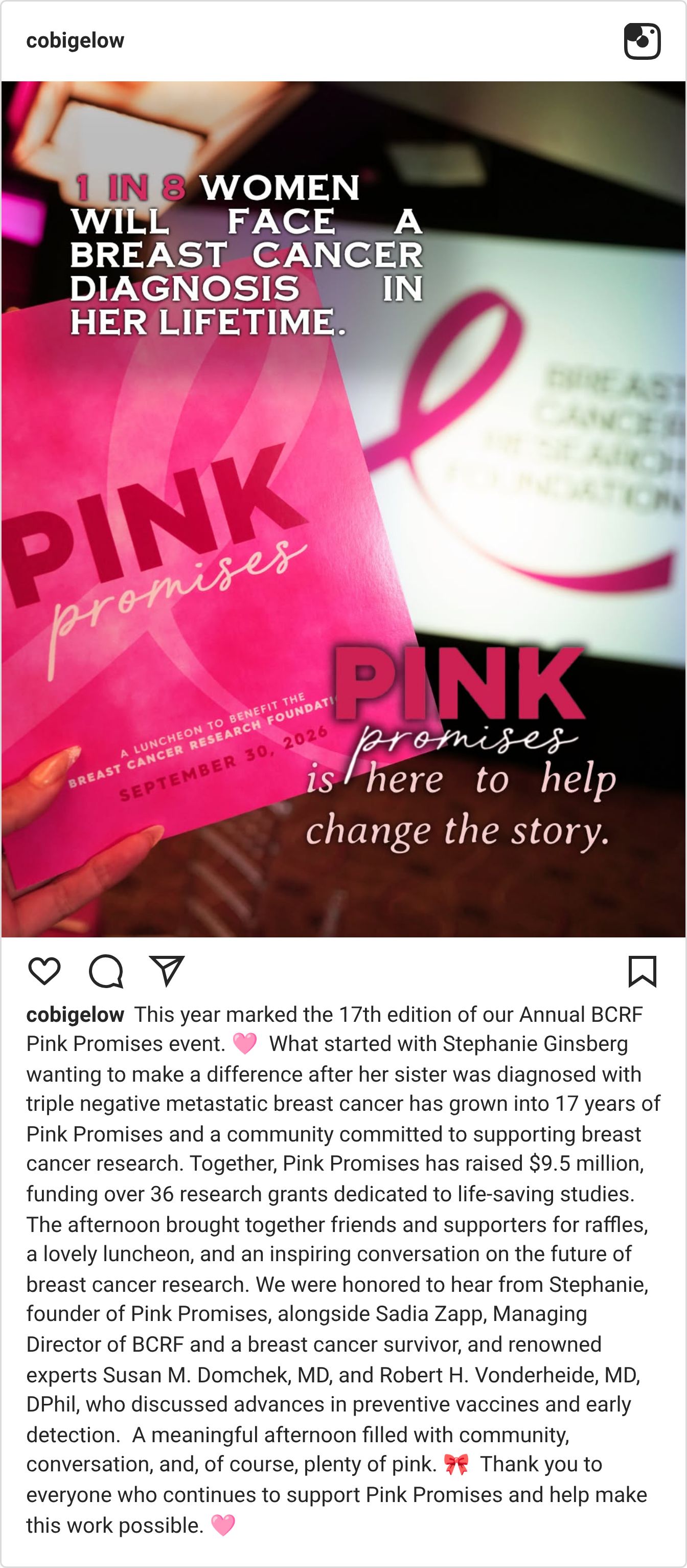
I've never given my mom a proper shoutout in Drugstore Cowboy, but this seems like as good an opportunity as I'll ever have.
My mom is a superstar.

Aforementioned Superstar
Between her work supporting breast cancer (through Pink Promises) and Alzheimer's research (through a yearly fundraiser called Memories Matter), she has helped raise more than $20 million toward advancing medicine.
She took the most frightening experiences our family has ever endured and turned them into more than fifteen years of helping people she will probably never meet.
And if you've ever wondered where I get my fighting spirit when it comes to healthcare, now you know.
I spend a lot of time in this newsletter criticizing the institutions, corporations, and policymakers who make American medicine so unnecessarily complicated.
But I also believe that medicine advances because of people who refuse to accept that the way things have always been done is necessarily the way they should continue.
People like Max. People like Betsy. And people like my mom.
The FDA has an immeasurably important responsibility to determine which medicines have been proven safe and effective. I don't want to live in a country where we abandon that responsibility.
But I also don't want to live in a country where a patient facing death is told that a promising treatment exists, only to discover that the system has no practical way to help them obtain it.
We should be able to protect the integrity of science without forgetting the humanity of the people waiting for its answers.
I'm proud to know a few people who are working to make that possible.
Giddy up!!

Alec Wade Ginsberg, PharmD, RPh
4th-Gen Pharmacist | Owner & COO, C.O. Bigelow
Founder, Drugstore Cowboy
